
A Practical, Inspiring Guide for Today’s Aspiring Homesteaders
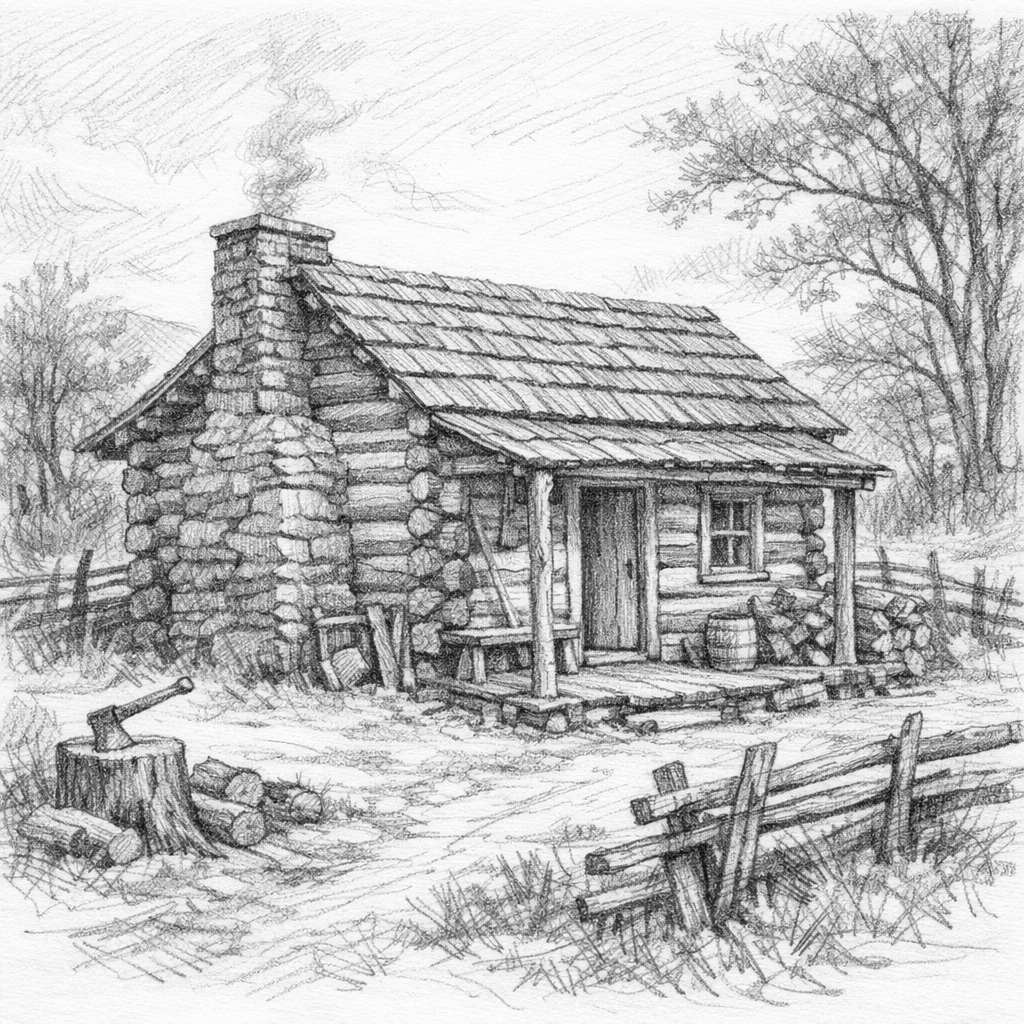
Building a cabin in the 1800s wasn’t a hobby—it was survival. Families arrived on the frontier with wagons full of hope but very few tools. What they did have, however, was ingenuity. With axes, saws, and grit, they raised homes that kept them warm through brutal winters and stood for generations.
Today, many new homesteaders feel drawn to that same simplicity. Whether you dream of building a full log cabin or just want to understand the mindset of early settlers, learning how pioneers worked with minimal tools can reshape how you approach your own land.
Let’s walk through the process step‑by‑step—just like they did.
1. Choosing the Right Cabin Site
Pioneers didn’t pick cabin sites based on aesthetics—they picked them for survival. They were careful and practical when choosing the perfect site for their log cabins. They looked for land near a reliable source of fresh water, such as a stream or spring, since it was essential for drinking, cooking, and farming. Good building timber had to be close by, so dense forests or woodlands were ideal. They also sought ground that was slightly elevated to avoid flooding, with good drainage and enough sunlight to support crops. Proximity to open land for planting and grazing animals mattered, too. By balancing all these needs—water, wood, safety, and fertile soil—pioneers selected sites that offered the best chance for survival and a strong, lasting home.
What They Looked For
- Proximity to water: A creek or spring within walking distance was ideal.
- South‑facing exposure: Maximized winter sunlight and warmth.
- Wind protection: Hills, tree lines, or rock outcroppings served as natural windbreaks.
- Abundant timber: The cabin materials needed to be right on-site or very close.
What This Means for You
For a modern person interested in homesteading, the pioneers’ approach to choosing a cabin site still offers practical guidance. Today, that means looking for land with dependable water access—whether a well, spring, or the ability to install reliable rain‑catchment—since water remains the heart of self‑sufficiency. It also means evaluating the availability of natural resources like timber or alternative building materials, good sunlight for gardening, and soil that can actually support crops. Just as pioneers sought higher ground to avoid floods, modern homesteaders consider drainage, wind exposure, and seasonal weather patterns when placing a home or garden. And because self‑reliance doesn’t mean isolation in the modern world, access to roads, supplies, and basic services still matters. By blending old‑fashioned practicality with modern needs, today’s homesteaders can choose land that supports a sustainable, resilient lifestyle.
2. The Essential Pioneer Tool Kit
Pioneers relied on a simple but indispensable collection of hand tools to build their log cabins, and each tool played a specific role in turning raw timber into a sturdy home. The felling axe was often the first tool put to work, used to cut down trees and trim away branches. Once the logs were down, a broad axe or adze helped shape and square them, creating flat surfaces so the walls would fit tightly and keep out wind and rain. Crosscut saws—usually handled by two people—made it possible to cut logs to length more quickly than with axes alone. Drawknives and froes were used for finer shaping tasks, like creating shingles, smoothing edges, or splitting smaller pieces of wood for interior work. Pioneers also relied on simple but vital tools like mallets, chisels, augers, and wedges to notch logs so they locked together securely at the corners. Even basic items such as wooden sleds or simple levers helped them move heavy logs into place without modern machinery. With only muscle, skill, and these rugged, reliable tools, pioneers created cabins that were warm, durable, and strong enough to withstand harsh weather and years of daily use.
Here were the essentials:
Core Tools
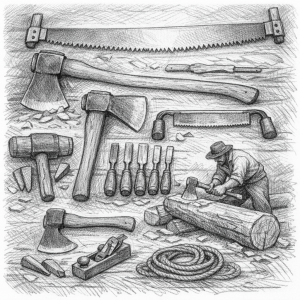
- Felling axe – For cutting down trees and rough shaping logs.
- Broad axe – For hewing logs flat.
- Crosscut saw – For cutting logs to length.
- Adze – For smoothing floors and shaping beams.
- Mallet & wooden wedges – For splitting logs.
- Chisels – For notching corners.
- Drawknife – For peeling bark.
Why This Matters Today
For a modern person stepping into homesteading, the simple pioneer toolset is a reminder that you don’t need a barn full of machinery to start building a self‑sufficient life—you just need reliable basics and the willingness to put in hands‑on work. While today’s homesteaders benefit from power tools like chainsaws, drills, and modern sawmills, the principles remain the same: good tools should be sturdy, repairable, and versatile enough to handle everything from felling trees to shaping boards or building shelters. Understanding how pioneers used axes, drawknives, and hand saws encourages modern homesteaders to value craftsmanship and learn foundational skills instead of relying solely on high‑tech solutions. It also highlights the importance of buying high‑quality tools you can maintain over years of use, rather than disposable gear. Whether someone is planning to build a small cabin, craft their own furniture, or simply manage their land responsibly, the pioneer mindset—skill, resilience, and resourcefulness—still applies just as much today. Modern homesteaders often feel they need expensive power tools to get started. But pioneers remind us that:
- Skill > equipment
- Technique > technology
- Patience > power
You can do a surprising amount with a small, well‑chosen set of tools.
3. Felling and Preparing Logs
Early pioneers put tremendous effort into felling and preparing logs before a single wall of a cabin could rise. They began by selecting straight, healthy trees—usually pine, oak, or chestnut—because straight grain meant stronger walls and easier shaping. Using felling axes and sometimes two‑man crosscut saws, they brought the trees down carefully, making angled cuts to control the direction of the fall. Once on the ground, pioneers trimmed off branches and peeled away bark, which helped the logs dry faster and prevented insects from settling in. They then cut the trunks to the needed lengths and used broad axes to hew the logs into flatter surfaces so they would stack tightly and shed drafts. Each log also had to be notched at the ends so it would lock securely with the next, a task requiring careful measuring and steady hands. This entire process—felling, trimming, peeling, shaping, and notching—was grueling and time‑consuming, but it allowed pioneers to turn raw forest into the strong, weather‑ready walls of a home built to last.
Step 1: Felling Trees
Pioneers relied heavily on axes and crosscut hand saws to bring down the trees needed for cabin building, and the process demanded both strength and precision. Using a felling axe, they would chop a deep, angled notch on the side of the tree facing the direction they wanted it to fall, then cut from the opposite side until the trunk gave way. For larger trees, two people worked together with a long, two‑handled crosscut saw, pulling in rhythm to slice cleanly through the wood. But choosing the right trees was just as important as the cutting itself. Pioneers sought out straight, tall, mature trees with minimal knots—qualities that made logs easier to shape and far stronger once stacked into walls. Species like pine, oak, cedar, chestnut, and spruce were common choices because they were durable, relatively easy to work, and plentiful in frontier forests. By selecting the best timber and relying on simple, dependable tools, pioneers ensured their cabins would be sturdy enough to withstand years of weather and hard living.
Step 2: Debarking
Early pioneers debarked logs, using drawknives, as an essential step in cabin building because removing the bark helped the wood last longer and made construction far easier. Bark traps moisture, insects, and fungi, all of which quickly rot a log if left in place, so pioneers used drawknives, hatchets, or even the edge of an axe to peel it away soon after felling a tree. Once stripped, the logs dried more evenly and resisted pests, making the finished cabin sturdier and more durable. Debarked logs also fit together more tightly, since the rough, uneven bark would otherwise create gaps that let in wind, rain, and cold. Smoother logs were simpler to notch and stack, allowing pioneers to create snug, well‑sealed walls. By taking the extra time to remove bark, they ensured their homes were stronger, warmer, and far better suited to withstand harsh frontier conditions.
Step 3: Hewing Logs
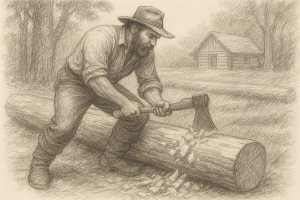
Pioneers hewed logs—shaping the rounded sides into flat surfaces with a broad axe—so the logs would fit snugly together, making their cabins stronger, tighter, and far more weather‑resistant. Using broad axes, they chipped away the curved outer layer of the log until they created two or more flat faces, which allowed the logs to stack evenly without large gaps that would leak wind or rain. This hewing process also made notching easier and more precise, since flat surfaces gave pioneers better control when carving corner joints that locked each log securely in place. Beyond creating tighter walls, hewed logs offered other important benefits: the flattened surfaces reduced drafts, required less chinking material, and made interior walls smoother and easier to clean. By investing the extra labor to hew their logs, early builders created cabins that were sturdier, warmer, and far more comfortable to live in through harsh frontier winters.
4. Corner Notching: The Secret to Strong Cabins
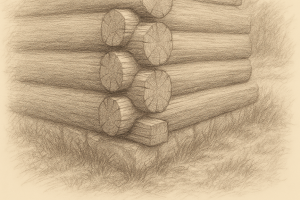
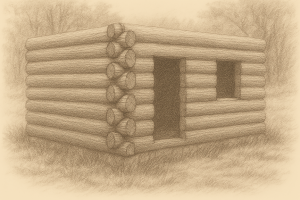
Pioneers notched the corners of their log cabins to lock the logs together securely, create stable walls, and ensure the cabin could withstand years of harsh weather and settling. Without nails or modern fasteners, notching was the key structural technique that kept a cabin from shifting or collapsing. By carving interlocking joints at the ends of logs, pioneers allowed gravity and the weight of the logs themselves to hold the entire structure tight and square. They used several types of notches, each suited to different needs and skill levels. The saddle notch, one of the most common, featured a rounded groove that fit snugly over the log beneath it, naturally tightening as the logs settled over time. The V‑notch, easier to cut, used angled cuts that formed a V‑shaped joint, providing simplicity and decent stability. The dovetail notch, more advanced, used angled, trapezoid-shaped cuts that locked the logs firmly in place and shed water outward, making it one of the best choices for long‑lasting, weather‑resistant cabins. Notching wasn’t simply about stacking wood—it provided structural integrity, prevented the walls from bulging or shifting, reduced drafts, and helped keep out rain and snow. By choosing the right notch and carving it carefully, pioneers ensured their cabins were sturdy, tightly sealed, and able to stand strong through decades of frontier living.
Why Notches Matter
5. Raising the Walls
To raise the walls of their log cabins, pioneers carefully stacked logs one layer at a time, beginning with the sill logs—the largest, straightest, and most durable logs placed directly on the foundation stones to form the cabin’s base. These sill logs were crucial because they supported the entire weight of the structure and needed to resist moisture and rot. Once the base was set, pioneers added successive courses of logs, aligning each one so that its corner notches locked securely with the log beneath it. As they worked upward, they used levers, ropes, and sheer muscle to maneuver the heavy logs into place, ensuring each layer sat tight to reduce drafts and strengthen the walls. Openings for windows and doors weren’t cut immediately; instead, the walls were built up completely, and once the structure was stable, pioneers cut out the needed spaces with axes and hand saws. They then reinforced the openings with vertical posts or frames to prevent the logs from shifting. By following this deliberate process—starting with strong sill logs, stacking each course carefully, and cutting openings only after the walls were well‑established—pioneers created cabins that were tight, sturdy, and capable of standing for generations.
Chinking and Daubing
Pioneers used chinking and daubing to seal the gaps between logs in their cabins, a crucial step for keeping out wind, rain, snow, and pests while improving warmth and overall comfort. Because even well‑hewn logs couldn’t fit perfectly together, they filled the larger gaps with chinking, which was usually made of sturdier, bulkier materials such as small stones, wood scraps, split sticks, or moss. This formed the base layer that blocked the widest openings. Over that, they applied daubing, a sticky, plaster‑like mixture used to smooth and seal the surface. Daubing materials varied by region but often included combinations of clay, mud, lime, sand, straw, grass, or animal hair to bind everything together. Some settlers even mixed in ash to deter insects. This layered method created a tight, weather‑resistant barrier that kept the cabin warm in winter, cool in summer, and far more livable year‑round. Chinking and daubing weren’t just details—they were essential to transforming a stack of logs into a true home capable of withstanding frontier conditions.
6. Building the Roof
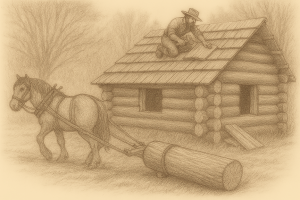
Building the roof of a pioneer log cabin was often the most dangerous and labor‑intensive phase of construction, requiring settlers to haul heavy timbers high above the ground and work while balancing on narrow, uneven log walls without any safety equipment. Once the walls were raised, pioneers constructed either rafter roofs, which used paired angled timbers meeting at a ridge to form a pitched structure, or purlin roofs, which relied on long horizontal logs laid across the gable ends, supporting smaller poles or boards laid perpendicular on top. Both methods demanded careful teamwork, as each log or beam had to be lifted into position by sheer muscle using ropes, poles, or makeshift scaffolding. After the frame was completed, pioneers covered it with shake roofs—hand‑split wooden shingles made by driving a froe into straight‑grained logs to produce thin, durable shakes. Splitting shakes alone could take days of steady labor, and installing them required meticulous layering to shed rain and snow. Despite the grueling work and constant risk of falls or slipping timbers, building a strong roof was absolutely critical: without it, the cabin’s walls would quickly rot, the interior would remain cold and damp, and the family inside would be left vulnerable to storms, snow, and wildlife. A well‑built roof transformed a simple log structure into a safe, durable home capable of enduring harsh frontier conditions for decades.
7. Floors, Doors, and Finishing Touches
Once the shell was complete, pioneers added the essentials.
Floors
Pioneer log cabin floors varied widely depending on time, skill, and available resources, with most settlers choosing between simple dirt floors or more labor‑intensive plank floors. Dirt floors were the quickest and easiest option—pioneers simply leveled and packed the earth inside the cabin, sometimes mixing in clay to create a harder, smoother surface. These floors were practical, required no tools or additional materials, and could be repaired as needed, which made them ideal for families just trying to get a roof overhead before winter. As time and resources allowed, many settlers upgraded to plank flooring, sawing or hewing boards from logs and laying them across supporting joists to create a cleaner, more comfortable surface. Plank floors helped keep out dampness, insects, and small animals, and they were far easier to sweep and maintain than packed earth. While dirt floors offered speed and simplicity, plank floors brought durability, comfort, and a greater sense of permanence—reflecting the pioneer’s gradual shift from mere survival to long‑term homesteading.
Doors and Windows
Pioneers added doors and windows to their log cabins only after the walls were fully raised and stable, carefully cutting out the openings with axes and hand saws to avoid weakening the structure. Once the holes were made, they installed door and window frames crafted from hand‑hewn boards, securing them tightly between the logs using wooden pegs or nails forged by a local blacksmith. Doors were typically built from thick wooden planks fastened together with cross‑braces for strength, while hinges were either handmade from iron—simple strap hinges hammered out on a frontier forge—or assembled from wood using pivot‑style pins when metal wasn’t available. Window openings were often small and covered with greased paper, oiled animal hide, or, if a family was fortunate, panes of glass transported from distant towns. Once set in place, frames were wedged or pegged firmly to keep them from shifting as the cabin walls settled. Through skilled carpentry, patience, and a bit of frontier ingenuity, pioneers turned rough log walls into functional living spaces with secure doors and practical windows that let in light while keeping out the elements.
Chimneys
Pioneers constructed and added chimneys to their log cabins using whatever materials were most accessible, often relying on stone, clay, mud, and hand‑formed sticks to create a sturdy, heat‑safe structure. In regions where stone was plentiful, settlers built solid stone chimneys, stacking rocks with clay or mud mortar to hold them together. In heavily forested areas, they sometimes constructed “stick‑and‑mud” chimneys, weaving small saplings or split sticks into a lattice and coating it thickly with clay to create a fire‑resistant shell. The chimney was usually attached to the outside of the cabin wall to reduce the risk of fire, and pioneers lined the interior of the fireplace with stone or packed clay for added protection. To fireproof the cabin itself, they coated nearby logs with clay or plaster‑like mixtures, kept the hearth area clear of debris, and often used a large hearthstone to protect the floor from stray embers. By combining local materials with careful craftsmanship, pioneers built chimneys that provided essential heat and cooking space while keeping their cabins as safe as possible from the ever‑present danger of fire.
8. What Pioneer Cabin Building Teaches Today’s Homesteaders
Pioneer cabin building teaches today’s homesteaders that self‑sufficiency begins with resourcefulness, patience, and an understanding of the land. The pioneers’ methods—selecting the right site, using locally available materials, shaping timber by hand, and building with simple yet durable techniques—remind modern builders that good craftsmanship and thoughtful planning matter more than expensive tools or high‑tech equipment. Their approach emphasizes working with the environment rather than against it: choosing the best trees, orienting the cabin for light and drainage, and crafting tight, weather‑resistant structures that could endure decades of harsh conditions. For today’s homesteaders, these lessons translate into valuing quality over speed, learning foundational skills rather than relying entirely on machinery, and embracing the idea that a sturdy, comfortable home can be built with what the land provides. Most of all, pioneer cabin building teaches resilience—showing that with determination, ingenuity, and hard work, even the most basic tools and materials can become a lasting shelter and a symbol of independence.
Lesson 1: Start with what you have. Pioneers didn’t wait for perfect tools or perfect conditions. They used what was available.
Lesson 2: Build skills, not just structures. Every log they shaped made them better craftsmen.
Lesson 3: Work with nature. They chose sites, materials, and designs that harmonized with the land.
Lesson 4: Slow, steady progress wins. Cabins weren’t built in a weekend. They were built one log at a time.
Lesson 5: Your homestead is a living project. Just like pioneer cabins, your homestead will evolve as your skills grow.
9. How You Can Start Your Own Pioneer‑Inspired Journey
Someone today can begin their own pioneer‑inspired journey by embracing the same mindset of patience, resourcefulness, and respect for the tools and land that guided early settlers, while also practicing modern safety and planning. A great starting point is learning fundamental skills—like firewood processing, simple carpentry, gardening, and food preservation—because these build confidence before tackling larger projects such as sheds or small cabins. Anyone wanting to work with axes, as the pioneers did, should prioritize axe safety: always keep both hands dry, maintain a sharp blade to prevent dangerous glancing blows, use a stable chopping block, and wear proper boots and eye protection. Begin with manageable tasks like limbing small branches or splitting kindling before attempting larger felling or hewing work. Modern homesteaders can also blend old and new by using hand tools for technique while relying on safer, efficient equipment—such as chainsaws or protective gear—to reduce risk. Studying how the pioneers selected building sites, shaped logs, and used local materials gives today’s homesteaders a blueprint for sustainable, low‑cost living, and starting small—whether with a garden bed, a simple outbuilding, or practicing with traditional tools—lets them build their skills gradually. With patience, preparation, and a willingness to learn, anyone can begin crafting a lifestyle rooted in independence and inspired by the resilience of the early frontier.
Practical First Steps
- Learn to use an axe safely.
- Practice felling and limbing small trees.
- Try hewing a log with a broad axe.
- Build a small structure: a shed, chicken coop, or wood rack.
- Study traditional joinery.
- Spend time observing your land—sun, wind, water, soil.
Books & Skills to Explore
- Log cabin construction
- Timber framing
- Green woodworking
- Bushcraft
- Traditional carpentry
Final Thoughts: You’re Part of a Long Tradition
Pioneer cabin building was never just about stacking logs into a shelter—it was an expression of freedom, independence, resilience, and hope, the same qualities that draw many people to homesteading today. For early settlers, each swing of the axe and each log lifted into place represented a belief that they could carve out a life with their own hands, far from established towns and comforts. Their cabins were more than buildings; they were symbols of courage and endurance, standing proof that ordinary people could confront hardships and still create something lasting. Modern homesteaders, even with better tools and more knowledge at their fingertips, are walking the same timeless path. When someone today decides to grow their own food, cut their own firewood, or build a simple outbuilding, they’re joining a long line of people who believed in the power of self‑reliance and the promise of a life shaped by their own effort. The pioneer spirit lives on in every person who looks at a piece of land—whether a few acres or a small backyard—and sees not just soil and trees, but the possibility of a future they can build themselves.
